
Excellence in Medical Education Series
The Excellence in Medical Education Series equips clinicians with practical, evidence‑based tools to strengthen their teaching—specifically within the unique context of rural medical education.
Designed for both new and experienced faculty, the series offers actionable strategies, shared insights, and resources that keep educators relevant and well‑supported in their evolving roles.
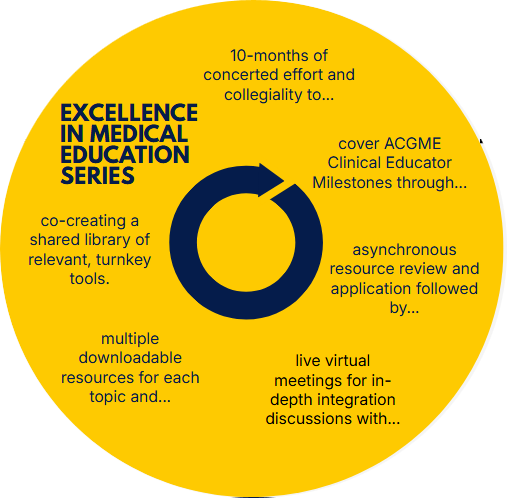
Participants engage in a blend of independent learning, application activities, live virtual sessions, and an individual project, averaging about five hours per month.
Who should attend?
Faculty who seek to:
solidify academic business skills
balance responsibilities as clinician and educator
gain confidence and remain relevant
network and collaborate
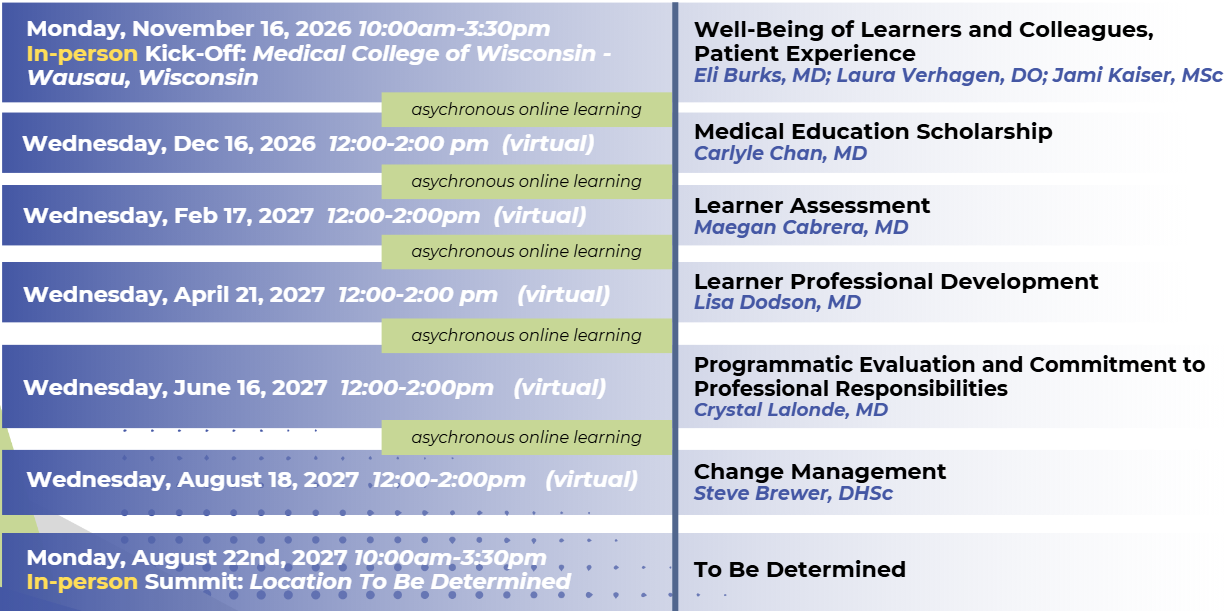
Schedule &
Speakers
Structure
The five virtual sessions combine independent learning, application activities, live sessions, and an individual project. Participants spend about five hours per month completing all requirements.
Independent Learning: Each session includes up to one hour of articles, videos, and milestone‑based content, plus a short application task to complete before the live session.
Application: Between sessions, participants spend one hour or less applying the milestone to their own work or program.
Live Virtual Sessions: Every other month, participants join a two‑hour interactive session that includes discussion and reflection on the application activity.
Individual Activity: Participants create a resource that strengthens their program within the covered milestones. All completed tools are shared across the cohort.
Requirements: Participants must attend both the in-person Kickoff and Summit. Participants may miss and make up no more than two live virtual sessions. If a live virtual session is missed, participants are required to review the session recording prior to the next session. In addition, participants are required to complete and submit a tool or resource developed through their individual activity.


Aligned with the ACGME Clinical Educator Milestones & rural-specific topics
Change Management
Level 2: Participates in change management initiatives
Level 3: Facilitates and manages change management initiatives
Learner Assessment
Level 2: Uses appropriate methods and tools for assessment in a specific setting
Level 3: Uses assessment data to identify strengths and opportunities for improvement of learners
Learner Professional Development
Level 2: Identifies approaches or strategies (e.g., learning plan) for different learners to provide coaching, sponsoring, advising, and/or mentoring
Level 3: Employs a variety of approaches or strategies for coaching, sponsoring, advising, and/or mentoring
Medical Education Scholarship
Level 2: Participates in medical education scholarship and the dissemination of educational approaches, curricula, and/or research
Level 3: Expands medical education scholarship or evidence through regular dissemination of educational approaches, curricula, and/or research findings
Programmatic Evaluation
Level 2: Describes the importance and elements of comprehensive programmatic evaluation / Describes how to create an action plan
Level 3: Conducts comprehensive programmatic evaluation for curricular areas of responsibility / Creates an action plan to address areas identified as needing improvement
Commitment to Professional Responsibilities
Level 2: Is timely in the performance of duties and takes responsibility for follow-up on details
Level 3: Takes responsibility for errors/professional lapses and initiates corrective action when indicated
In support of improving patient care, this activity has been planned and implemented by the University of Wisconsin–Madison ICEP and Wisconsin Northern & Central (WiNC) Graduate Medical Education (GME) Consortium. The University of Wisconsin–Madison ICEP is jointly accredited by the Accreditation Council for Continuing Medical Education (ACCME), the Accreditation Council for Pharmacy Education (ACPE), and the American Nurses Credentialing Center (ANCC), to provide continuing education for the healthcare team. This program offers up to 25 CME credits.
Excellence in Medical Education Series 2027/2028 Topics
Administrative Skills
Curriculum
Feedback
Learning Environment
Performance Improvement & Remediation
Professionalism in the Learning Environment
Science of Learning
Teaching & Facilitating Learning
Additional topics to be determined based on program needs
Excellence in Medical Education Series 2026/2027 Topics
Change Management
Learner Assessment
Learner Professional Development
Medical Education Scholarship
Programmatic Evaluation
Commitment to Professional Responsibilities